
Opportunities and Events
Ambassador calls for accountable leadership, stronger institutions, resource-driven development, says Africa must take charge of its economic destiny By Raymond Enoch

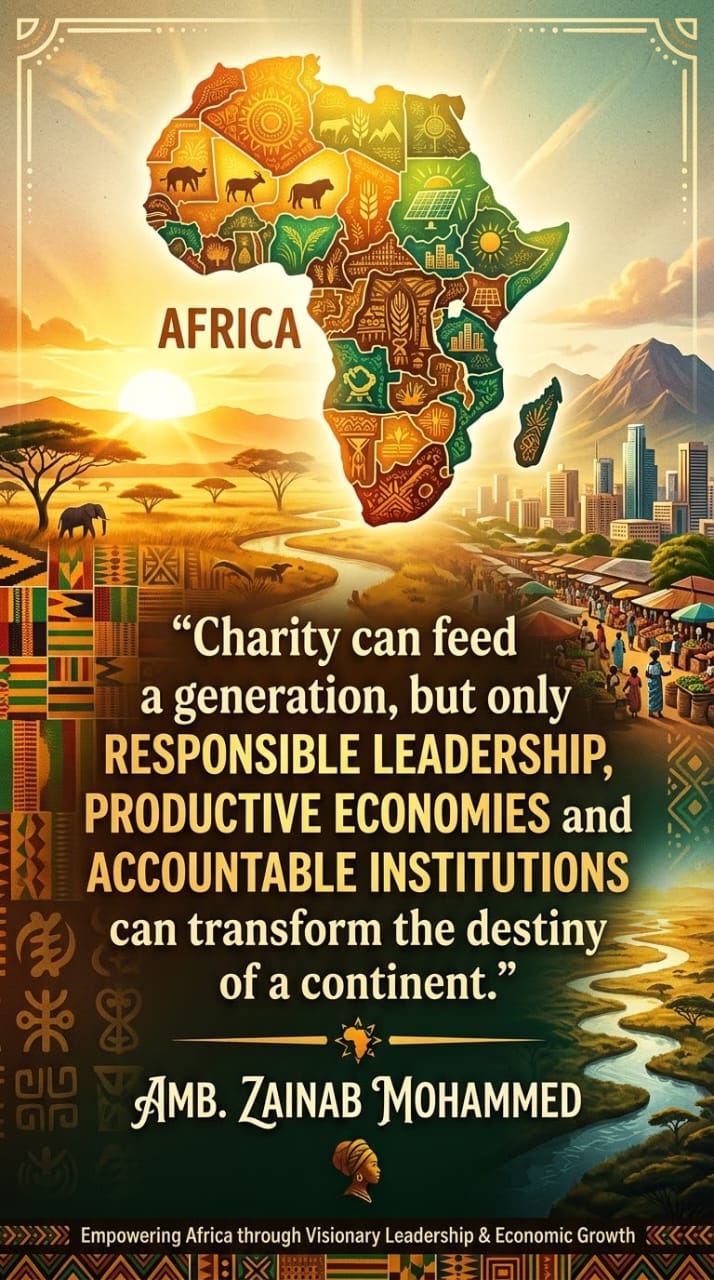
Ambassador Zainab Mohammed has challenged African leaders and citizens to move beyond dependence on foreign aid and humanitarian charity, insisting that the continent’s enduring poverty is not necessarily a reflection of its lack of resources but of its failure to translate enormous natural and human wealth into prosperity for its people.
Mohammed, in a strongly worded statement reflecting on the 41st anniversary of the historic humanitarian song We Are the World, argued that Africa must urgently embrace accountable leadership, institutional reforms, economic self-reliance and collective responsibility if it is to overcome persistent poverty and underdevelopment.
She said the continent, despite its abundant mineral resources, fertile agricultural land, youthful population, energy potential and entrepreneurial capacity, continues to grapple with hunger, unemployment, inequality, food insecurity and inadequate social infrastructure.
The ambassador’s intervention comes as the world reflects on the legacy of We Are the World, the iconic charity single released on March 7, 1985, by the supergroup USA for Africa, with proceeds directed towards famine relief in Africa.
Written by Michael Jackson and Lionel Richie and produced by Quincy Jones, the song brought together leading international music stars in an unprecedented demonstration of global solidarity and humanitarian compassion.
However, Mohammed questioned how much progress Africa had made since that historic intervention, asking whether the continent had sufficiently addressed hunger, extreme poverty and the structural weaknesses preventing millions of its people from enjoying decent living standards.
She maintained that while international assistance had contributed to humanitarian interventions and development programmes, decades of external support had not eliminated the fundamental challenges confronting many African societies.
According to her, the central issue is no longer how much the international community can donate to Africa but why a continent so richly endowed with natural resources, human capital and economic opportunities continues to experience widespread deprivation.
She identified leadership failures, corruption, weak institutions, political instability and economic mismanagement as critical issues requiring urgent attention, while acknowledging that colonial legacies, external exploitation, unequal global trade relationships, conflicts and climate change also contribute to Africa’s development challenges.
Mohammed, however, cautioned against making external factors the sole explanation for the continent’s predicament, stressing that African governments, institutions, businesses and citizens must accept their share of responsibility for the continent’s development outcomes.
On the possibility of another global humanitarian initiative similar to We Are the World, she observed that international solidarity remains valuable, particularly during humanitarian emergencies, but argued that fundraising concerts and charitable donations cannot replace sustainable economic policies, industrialisation and responsible governance.
She stressed that Africa needs more than humanitarian fundraising, calling instead for what she described as a development revolution anchored on production, innovation, ownership and accountability.
The ambassador advocated increased investment by African businesses within the continent, stronger government support for enterprise, improved domestic financing mechanisms and the development of homegrown solutions to Africa’s economic and social challenges.
On foreign aid, Mohammed maintained that Africa should not reject genuine international partnerships or humanitarian assistance, particularly during wars, famine, natural disasters and public health emergencies.
She nevertheless warned that foreign assistance must not become a substitute for national responsibility or a permanent development strategy.
She called on African countries to strengthen their capacity to finance domestic priorities, mobilise internal resources, expand regional trade, develop local industries and add value to their natural resources rather than continue exporting raw materials while importing finished products at higher costs.
According to her, Africa’s objective should not be to isolate itself from the international community but to engage global partners from a position of strength, confidence and mutual benefit.
Mohammed also urged African governments to move beyond political promises and demonstrate measurable development results, insisting that the continent’s future must be driven by institutions that promote transparency, accountability and opportunities for its growing population.
She called on the private sector to invest in productive industries, the African diaspora to assume a more strategic role in development, civil society organisations to intensify demands for transparency and citizens to embrace the responsibility of building societies that reward integrity, hard work and innovation.
She further argued that Africa must change the benchmarks through which its development is measured, moving away from the volume of foreign assistance received to indicators such as wealth creation, employment generation, poverty reduction and improved living standards.
In her concluding message, Mohammed said the greatest tribute Africa could pay to the humanitarian vision behind We Are the World would be to build a continent where children do not go hungry, poverty does not determine people’s destinies and natural resources translate into opportunities and dignity for citizens.
“The world can stand with Africa, but Africans must lead Africa’s transformation,” she declared.
She reaffirmed her position with a call for African ownership of the continent’s development agenda, encapsulated in the message: “Africa for Africans. African resources for African development. African leadership for African prosperity.”
Mohammed stressed that the time had come for Africa to change its development narrative and assume a more decisive role in shaping its economic and political future.


