
Business
ECOWAS, Nine Member States Sign Accra Convention to Accelerate Trade Facilitation, Regional Connectivity By Raymond Enoch

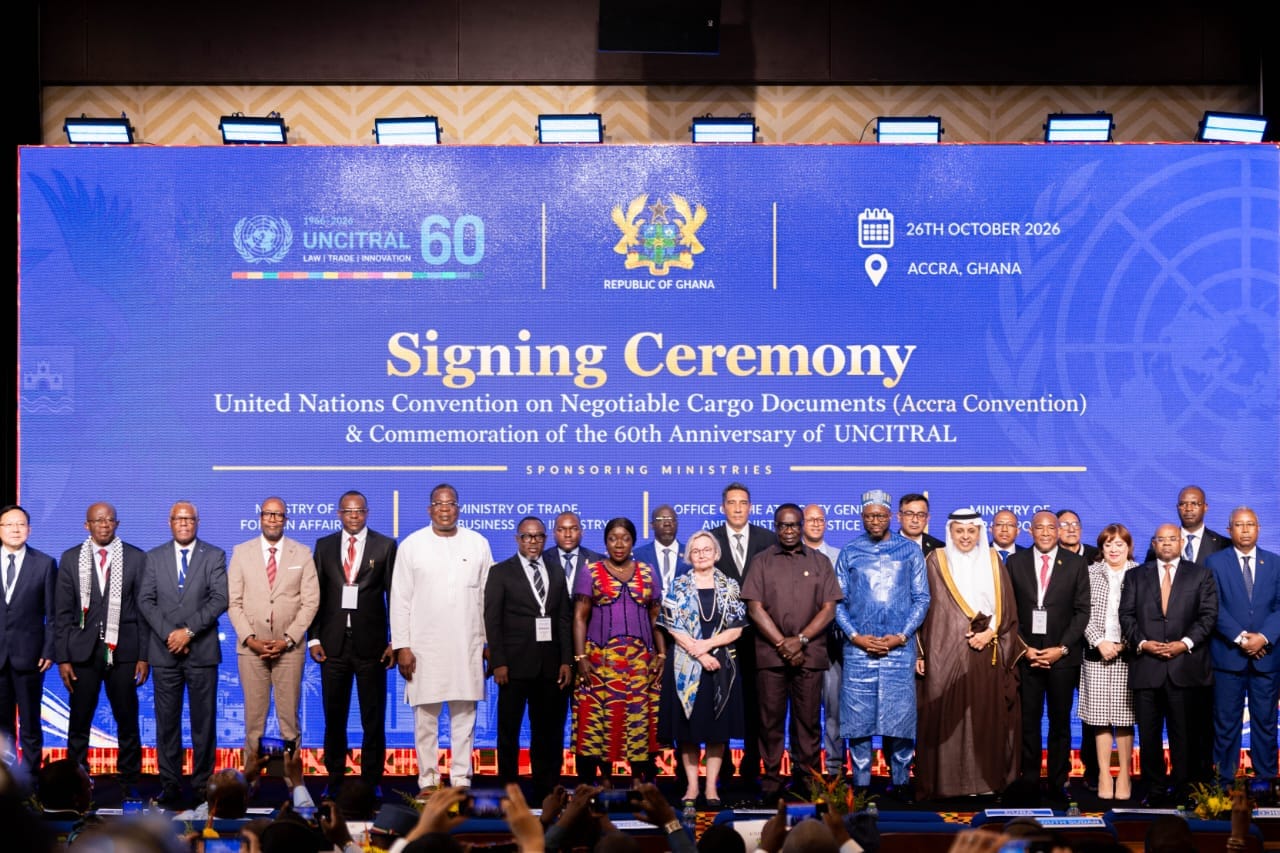
The Economic Community of West African States (ECOWAS) has reaffirmed its commitment to dismantling trade barriers, strengthening cross-border connectivity and accelerating regional economic integration following the signing of the United Nations Convention on Negotiable Cargo Documents, popularly known as the Accra Convention, by nine of its Member States.

The historic signing ceremony, held on October 26, 2026, in Accra, Ghana, brought together 26 countries that endorsed the landmark international legal instrument, marking a significant step towards modernising cargo documentation, streamlining cross-border trade and improving the movement of goods across different transport networks.
The nine ECOWAS Member States that signed the Convention are Cabo Verde, Côte d’Ivoire, The Gambia, Ghana, Guinea, Guinea-Bissau, Nigeria, Sierra Leone and Togo, reflecting growing regional recognition of the importance of harmonised trade procedures and efficient transport systems in unlocking West Africa’s economic potential.
The development represents an important milestone in ECOWAS’ broader efforts to deepen economic cooperation, strengthen trade competitiveness and create a more seamless regional market in line with its integration objectives.
At the heart of the Accra Convention is the introduction of a single negotiable cargo document, available in both paper and electronic formats, designed to cover goods transported across multiple modes of transportation and international borders.
The framework is expected to address some of the longstanding operational challenges associated with fragmented cargo documentation, inefficient information exchange and cumbersome procedures that frequently delay the movement of goods across regional trade corridors.
By establishing a harmonised documentary framework, the Convention could significantly simplify trade transactions, improve transparency, facilitate the exchange of commercial information and enhance the efficiency of multimodal transportation across participating countries.
For West Africa, where the movement of goods across borders remains central to regional economic development, the initiative offers an opportunity to strengthen the institutional and operational foundations of trade facilitation.
ECOWAS’ involvement in the process also underscores the Commission’s determination to ensure that international trade instruments complement existing regional mechanisms rather than operate independently of them.
Ahead of the signing ceremony, the ECOWAS Commission, in collaboration with Ghana’s Ministry of Trade, Agribusiness and Industry and the Secretariat of the United Nations Commission on International Trade Law (UNCITRAL), organised a virtual sensitisation session on October 7, 2026, to familiarise Member States with the Convention’s provisions, practical applications and potential implications for regional commerce.
The engagement provided an important platform for building awareness, encouraging national participation and strengthening understanding of how the Convention could contribute to the modernisation of trade and transport operations across the ECOWAS region.
Significantly, the Accra Convention is expected to complement ongoing regional efforts to consolidate the ECOWAS Trade Liberalisation Scheme (ETLS), strengthen customs cooperation and improve the efficiency of transit operations.
It also offers an opportunity to reinforce the implementation of the ECOWAS Transit Procedure, established under Supplementary Act A/SA.2/12/21, alongside the Interconnected System for the Management of Goods in Transit (SIGMAT), which facilitates the electronic exchange of transit information among customs administrations.
The alignment of these initiatives is particularly important as ECOWAS intensifies efforts to address non-tariff barriers, reduce administrative bottlenecks and improve the predictability of cross-border trade.
For businesses, transport operators, exporters and importers, more efficient cargo documentation could translate into reduced transaction costs, faster clearance processes and improved reliability across regional supply chains.
Beyond its immediate trade facilitation benefits, the Convention carries broader implications for West Africa’s competitiveness within the African Continental Free Trade Area (AfCFTA) and the global trading system.
As countries seek to expand intra-African commerce and attract greater investment into logistics, manufacturing and infrastructure, the ability to move goods efficiently across borders remains a critical determinant of economic performance.
The participation of nine ECOWAS countries in the Accra signing therefore signals an important convergence between international legal cooperation and the region’s longstanding ambition to establish an integrated, competitive and commercially vibrant West African economy.
However, the real value of the Convention will ultimately depend on effective national implementation, appropriate legal and institutional arrangements, digital infrastructure and sustained cooperation among customs authorities, transport regulators and other relevant stakeholders.
For ECOWAS, the challenge and opportunity lie in translating the commitments demonstrated in Accra into practical improvements at border posts, ports, inland transport corridors and customs administrations.
The Accra Convention thus represents more than another international agreement. It provides a potential instrument for connecting markets, modernising trade processes and advancing the vision of a West Africa where the movement of goods is increasingly seamless, efficient and predictable.


